
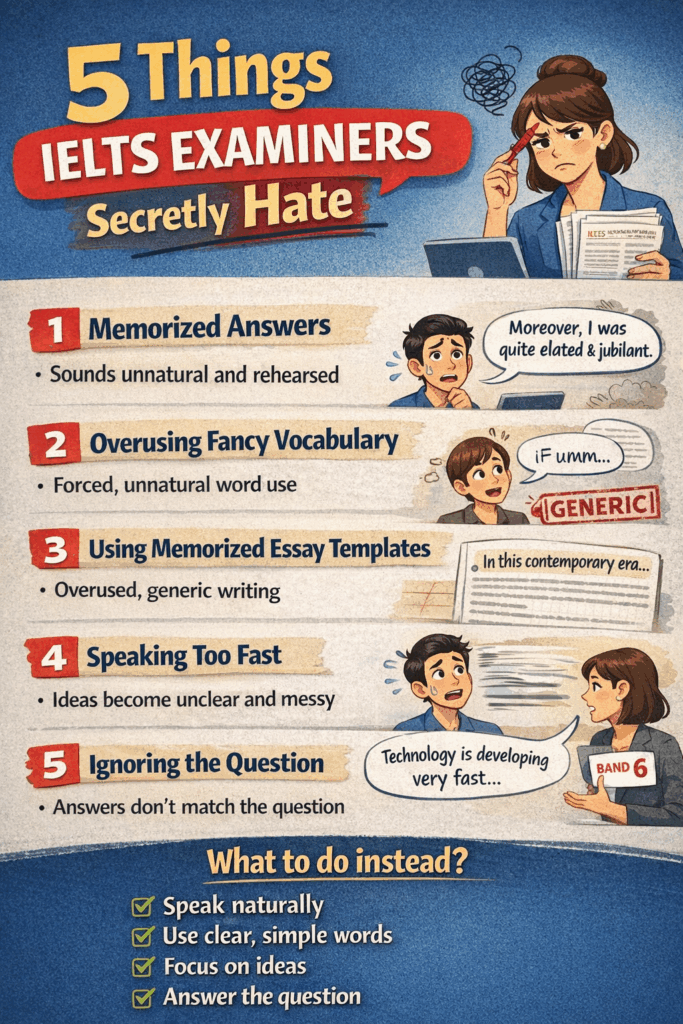
Many IELTS students spend months memorizing vocabulary lists, studying templates, and practicing model answers. But as a former IELTS examiner, I can tell you that some of the things students believe will improve their score actually have the opposite effect.
Examiners are trained to follow strict scoring criteria, but over time we also notice certain habits that make answers sound unnatural, rehearsed, or unclear. These mistakes are incredibly common — and they can quietly lower your band score.
Here are five things IELTS examiners secretly hate (and what you should do instead).
1. Memorized Answers
One of the easiest things for an examiner to detect is a memorized response.
Many students prepare long, perfect answers for common questions like:
- Describe your hometown.
- Talk about your favorite book.
- Describe a person you admire.
The problem is that memorized answers often sound too perfect or unnatural. Students suddenly switch to very complex vocabulary or unnatural sentence patterns that don’t match the rest of their speaking.
For example:
“Well, that’s a very fascinating topic and I would be absolutely delighted to elaborate on it.”
No one speaks like that in real life.
When examiners suspect memorization, they will often change the question slightly or ask follow-up questions. If the student struggles to respond naturally, it becomes clear that the answer was rehearsed.
What to do instead:
Prepare ideas, not scripts. Practice talking about topics naturally rather than memorizing full answers.
2. Overusing Fancy Vocabulary
Students often believe that using big or complicated words will automatically increase their score.
Unfortunately, this strategy often backfires.
Examiners frequently hear sentences like:
“I was utterly exhilarated and tremendously fascinated by the magnificent scenery.”
These words are sometimes used incorrectly or in unnatural combinations. This creates what examiners call “forced vocabulary.”
IELTS does reward strong vocabulary, but the key is natural usage, not complexity.
Compare these two sentences:
- “The scenery was absolutely magnificent and tremendously breathtaking.”
- “The scenery was beautiful and really peaceful.”
The second sentence sounds more natural and clear.
What to do instead:
Focus on accurate vocabulary and natural collocations, not complicated words.
3. Using Memorized Essay Templates
This problem appears most often in IELTS Writing Task 2.
Many students memorize introductions like:
“In this contemporary era, the issue of X has become a matter of heated debate.”
Examiners have seen this sentence thousands of times.
Templates often create several problems:
- They sound unnatural
- They do not fit the question properly
- They make essays look very similar
IELTS examiners are trained to identify formulaic writing, which can reduce your Task Response and Coherence scores.
What to do instead:
Learn simple, flexible structures, such as:
- Introduction
- Two body paragraphs
- Conclusion
Focus on clear ideas and explanations, not memorized phrases.
4. Speaking Too Fast
Many students believe that speaking quickly shows fluency. In reality, speaking too fast can make your answer difficult to understand.
When students rush their speech, several problems appear:
- Pronunciation becomes unclear
- Grammar mistakes increase
- Ideas become disorganized
Examiners care about clarity, not speed.
In fact, a slightly slower speaker who communicates clearly will often receive a higher score than someone who speaks quickly but unclearly.
What to do instead:
Speak at a natural, comfortable pace. Focus on expressing ideas clearly rather than trying to sound fast or impressive.
5. Ignoring the Question
This is one of the most frustrating things examiners see.
Sometimes students learn a topic and try to force their prepared answer, even when it does not match the question.
For example, if the examiner asks:
“Do you prefer studying alone or with others?”
A student might respond with a long memorized speech about education systems or technology, which does not answer the question.
In writing, students sometimes discuss a different topic entirely because they prepared an essay in advance.
When you do not answer the question directly, your Task Response score drops immediately.
What to do instead:
Always make sure your answer directly addresses the question before adding extra ideas.
Final Thoughts
IELTS examiners are not looking for perfect English or impressive vocabulary. What they want to see is clear communication, natural language, and relevant answers.
If you avoid these five common mistakes, you will already be ahead of many test takers.
Remember:
- Do not memorize answers
- Use vocabulary naturally
- Focus on clear ideas
- Speak at a comfortable pace
- Always answer the question
These simple changes can make a significant difference to your IELTS band score.

They can help me avoid some secret points that will lower my grades.Thanks